Holdem Pot Odds
Texas Holdem Odds Calculator. Omaha Holdem Odds Calculator. Omaha Hi/Lo Odds Calculator. Holdem Preflop Odds. These tables are computed by simulating or enumerating millions or billions of hands to give some useful numbers for playing poker. Texas Holdem 10 Player Preflop Odds. Texas Holdem Heads-Up Preflop Odds. Texas Holdem Preflop Nut Odds. The most straightforward explanation of how to calculate pot odds is to compare the total number of unknown cards to how many outs you have, and then do some simple division. For example, if you are four to a nut flush on the turn of a Texas Hold 'em game, there are 46 unknown cards, (52 minus your 2 pocket cards and 4 on the board).

After the flop, your play will depend on many factors, including information gathered pre-flop, what you know of your opponents and how they play, and the probabilities of having or making the best hand. If you have hit top pair with a strong kicker on the flop, then you have a strong hand and should bet at the pot. But the more difficult scenario is when you have flopped a flush draw or a straight draw, or perhaps an inside straight draw with two over cards. If someone bets, should you make the call?
At this point, it is important to first surmise what your opponent’s hand is. Then, you must calculate the number of outs you have to make your hand the winning hand. The final step is to then understand the probabilities of hitting one of your outs, giving you the winning hand. These are all crucial steps in the decision making process.
For example, let’s say I am holding JT offsuit.
The flop comes A 8 9 – rainbow.
Texas Holdem Pot Odds Calculator
The pot is current at $8.00, and Player1 bets $2.00. Everyone else folds.
Should I make the call?
Well, first I should think about what he may be holding. Let’s say there was no pre-flop raise and Player1 is in early position. He may have a pair of Aces with no kicker, or maybe a pair of 9’s.
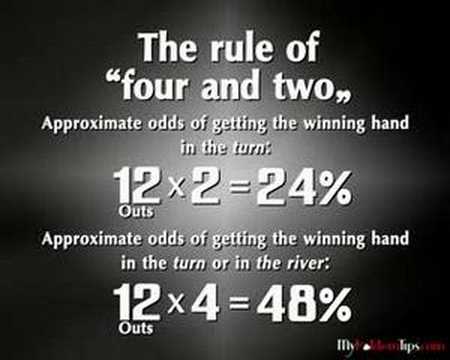
So, if I put him on a pair of Ace’s, then I would need either a 7 or a Q to complete my straight and win the hand. Therefore, I have 8 outs – the four 7’s in the deck plus the four Q’s in the deck.
Now, if I have 8 outs, here is the calculation of hitting one of my cards on the turn or river:
There are 47 cards left unseen (I’m holding 2, there are 3 on the board, 52-5= 47). 47 – 8 outs = 39.
My calculation becomes: 1 – 39/47 (turn) * 38/46 (46 cards unseen prior to river):
1 – 39/47 * 38/46 = 31.5%
I have a 31.5% chance to hit my hand over the turn and river.
Now back to our scenario, I have to call a $2.00 bet to win what will be a $12.00 pot. Since my bet is only about 17% of the pot, yet I have a 31.5% chance of winning (across the turn & river card!), the “pot odds” justify making the call.
Now let’s say Player1 bets $12 instead of $2. I would have to call $12 to win what will be a $32 pot. My bet is 37.5% of the pot, greater than my odds of hitting one of my outs, and therefore I should fold (we will get to implied odds further down).
The above scenarios are important to grasp. Picture yourself on the flip side now. Let’s say you have a pair of Aces, and you do not want to allow someone to out draw you. You should do exactly what was outlined above – bet more than their odds would justify. If you bet the amount of the pot, then those chasing the straight (or the flush for that matter) are not getting proper pot odds to call, so you either force them to fold, or you force them to play incorrectly and chase a hand when they are betting against the odds. Your bet can help cause your opponents to make mistakes and incorrectly play their flush draw or straight draw.
So, how are you supposed to calculate your probabilities on the fly in the heat of battle… without a calculator? You don’t. See the chart below! You can right click and save the chart on your computer and even print it off to look at whenever you need!
Memorize these figures (particularly the first chart), they will help you justify your calls. Now, the above scenarios were pretty simplified. There are other, more advanced, factors to potentially consider. For example, if you do not hit your card on the turn, can you assume Player1 will bet again and how much? If you know this information, this should also be included in your calculation of the bet vs. pot amounts.
Let’s say you know Player1 will probably bet another $4 on the turn. So really, you are looking at calling $6.00 against a pot of $16.00. The percentage now is 37.5% (6/16) as opposed to our earlier example where it was 17%. In this case, the call isn’t as clear and the current pot odds don’t quite justify the call because 37.5% is greater than our 31.5%. However, there are implied odds to consider, and these odds may justify making this call.
Texas Holdem Pot Odds Chart
This is the last factor that is important to consider; implied odds. In the game of No-Limit Hold’em, you potentially could win a much larger pot than the current pot you are calculating your odds against. If you do hit your hand, could you then bet the entire pot amount and assume Player1 will call? How much of a bankroll does Player1 have and is it possible to take it all on this hand? These are interesting questions and also can affect your decision. The total pot size at the very end of the hand, could easily justify making the call in the hopes of winning that pot. This is called “implied odds” and should also be considered.
Calculating Outs
Now go play and try incorporating this knowledge. I would say good luck, but luck is the enemy of a good player. Better yet, good pot odds!
You can test out some of this basic strategy and get some practice working with pot odds playing at REAL MONEY TABLES without making a deposit! Check out our list of No Deposit Bonus Poker Rooms. These online poker rooms offer new players a real dollar bonus without ever making an initial deposit! So once you register, get some practice at the real money tables, and hopefully make some money, with no risk to your bankroll!