Saving Interest Rates
Jan 03, 2021 Saving Schemes List: Types, Interest Rates & Tenures You can invest in a host of savings schemes in India, many of which carry tax deductions and exemptions under the Income Tax Act, 1961. In this article, we will give you an overview of the different savings schemes available in term of returns, ease of investment, taxability of income. Sadly, compound interest tends to have an even bigger impact on debts than on savings, because interest rates are higher. Borrow £1,000 at 15% over 20 years without making any repayments, and you'd owe a massive £16,400 (without compound interest it'd be £4,000). Jul 01, 2018 The link between interest rates and saving is not clear because many factors affect saving. In 2009, the household saving ratio increased from 0.5% to over 8% – despite a cut in interest rates from 5 to 0.5%.
A savings calculator is a tool used to help you figure out how much money you will make over time when placing an initial amount or additional contributions into an interest-earning account. There are many reasons why having an interest-earning savings account is important for financial health, whether you’re using it to build up an emergency fund or to fulfill a travel dream or wedding.
It’s generally a good idea to have three to six months of your expenses saved in your emergency fund. A savings calculator helps determine how much money you accrue in addition to the emergency savings you have sitting in your account.
Information and interactive calculators are made available to you as self-help tools for your independent use and are not intended to provide investment advice. We cannot and do not guarantee their applicability or accuracy in regards to your individual circumstances. All examples are hypothetical and are for illustrative purposes. We encourage you to seek personalized advice from qualified professionals regarding all personal finance issues.
How to use a savings calculator
The interest that builds on top of your account balance can be determined by a savings calculator, to help you figure out how much you will be making over a long period.
The longer the money stays in the account, the more you accrue in interest. The great thing about interest-earning accounts is that you not only earn money on your balance or deposits but also on the interest earnings accrued over time, this is also known as compound interest. Here are a few tips on how to use a savings calculator.
- Calculate the numbers without a monthly deposit. By doing this, you are figuring out how much interest your balance is generating annually.
- Calculate again by adding a regular monthly deposit to see how a recurring deposit makes a difference in your total savings amount.
- Enter a different number of years to determine how much your interest grows your account over a while. Start with five years, increased to 10, increased to 20 and so on. This allows you to plan for long-term decisions such as retirement and develop a living yearly salary budget to depend on once you are no longer working.
How to boost your savings
Saving Interest Rates

1. Open an interest-bearing savings account
You want to place any money you can spare into one of these accounts because when left untouched, it compounds interest annually meaning you are making money on the interest accrued from the previous year. If you don’t need the money right away anyway, then this is what you should do with it to make money from money. Some of the best interest-bearing accounts come from online banks like Ally or Synchrony.
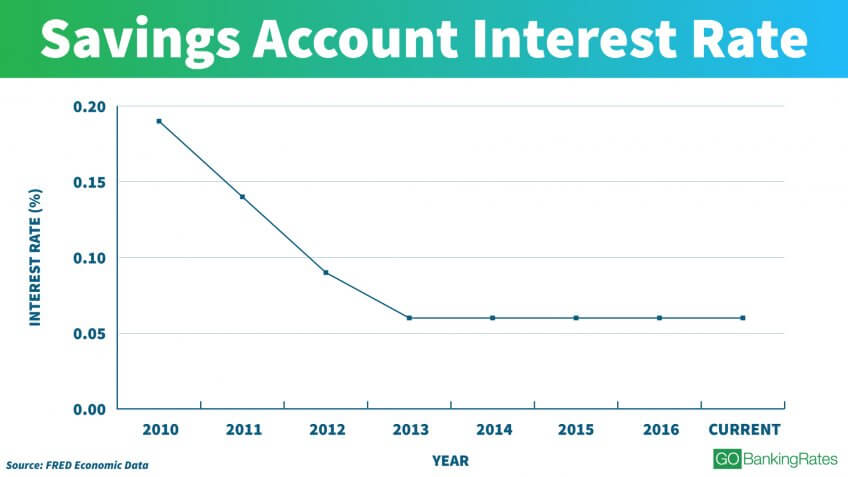
It’s important to keep in mind that each account will vary in APY offered. Although the national average is 0.09% APY, it’s possible to find accounts that offer well above this. That said, make sure to compare different high-yield savings account before selecting one to earn the best rate.
2. Choose an inconvenient bank or auto-transfer
Picking a bank that is hard to access increases your savings amount because it means you won’t be tempted to make withdrawals on a regular basis. Some banks have “funding holds” so that a release of your funds can take anywhere from 24 hours to five business days. While it may seem off-putting at first, this “inconvenience” can help you avoid any spontaneous and unnecessary purchases.
Furthermore, setting up a small weekly or bi-weekly transfer from your checking account to your savings account can help increase your savings. Come up with an amount that you won’t miss on a weekly basis, such as $20 a week or $50 every time your paycheck deposits.
3. Roundup savings apps
Roundup savings works as an automatic savings account that includes the spare change from purchases you make. For instance, if you buy something for $4.95, the total would round up to charging you $5 and deposit the extra 5 cents into your roundup savings account.
Some great apps to look into include Acorns, Chime, and Qapital. If you choose to save through simple things, this is a great place to see that money accumulate and keep your momentum going. Some apps — like Chime — also come with their own competitive interest rates so be sure you take the time to compare the perks.
4. Choose auto-pay and eliminate subscriptions
You’d be amazed by the amount of money you unknowingly spend monthly. Two common culprits are overdue fines and subscription fees. If you have the cash on hand, saving on late fees is as simple as setting your accounts for auto-pay.

You may even find that you “accidentally save” on bills that are lower than your auto-pay amount, in which case you’ll typically receive a credit for the following month. Some providers even offer an added discount for auto-pay accounts or accounts that go paper-free. Set up typically takes a few minutes but can save you hundreds on late fees.
If you’ve ever signed up for a free seven-day or 30-day trial thinking “I’ll just cancel this before it expires” only to forget all about it, you’re not alone. Companies count on the fact that you’ll forget you ever signed up. Take some time to look into any “mysterious charges” to your account and cancel any subscriptions you no longer need.
The impact of 1% savings over time
According to the U.S. Bureau of Labor Statistics, the pre-tax median income for someone in 2019 living in the United States was $48,672. If they were to take 1% of their income to invest as principal in an interest-earning account, it would be a $486.72 initial investment. If $486.72 was invested in a savings account each year for five years at a rate of .09% APY, the total in the account, by the end of those five years $219 would be gained in interest.
As you can see, just investing a small, seemingly insignificant amount of 1% of your income has a very large, significant impact on your savings account.
Shorebank Direct
Interest rates determine the amount of interest payments that savers will receive on their deposits.
- An increase in interest rates will make saving more attractive and should encourage saving.
- A cut in interest rates will reduce the rewards of saving and will tend to discourage saving.
However, in the real world, it is more complicated. The link between interest rates and saving is not clear because many factors affect saving.
In 2009, the household saving ratio increased from 0.5% to over 8% – despite a cut in interest rates from 5 to 0.5%. This was because the impact of the recession encouraged saving. The fear of unemployment and recession was greater than the effect of lower interest rates
Income and substitution effect of higher interest rates.
- If interest rates fall, the reward from saving falls. It becomes relatively more attractive to hold cash and/or spend. This is the substitution effect – with lower interest rates, consumers substitute saving for spending.
- However, if interest rates fall, savers see a decline in income because they receive lower income payments. A pensioner relying on interest payments from saving may feel he needs to save more to maintain their target income from savings.
Saving Interest Rates
Usually, the substitution effect dominates. Lower interest rates make saving less attractive. But, for some, the income effect may dominate, and people may respond to lower interest rates by saving more to maintain their standard of living.
Alternatively, a lower interest rate may encourage other forms of saving and investment. With very low bank rates, it has encouraged people to look for better yields in the stock market. This is one reason why the stock market did well in the great recession of 2008-2013 – savers have been buying shares to get a better rate of interest rate than they can in a bank and on bonds.
Base rates and bank rates
Usually, a cut in Central Bank base rates leads to an equivalent fall in bank rates. However, in the aftermath of the credit crunch, bank rates didn’t fall as much as base rates. In the UK, bank rates (e.g. Libor were higher). Therefore, the cut in base rates didn’t have as much impact. After the impact of the credit crunch diminished the UK saw a fall in Libor rates, and bank rates came closer to base rates.
(instant access saving rates starts Jan 2011.)
- Before the crisis, 1-year fixed rate saving bonds were very close to the Bank of England base rate.
- However, 1-year saving rates in 2009 only fell to 3% in 2009, meaning savers were protected from the full cut in base rates.
- However, since the Funding for Lending scheme was introduced in 2012, saving rates have fallen for both 1-year fixed and interest rates on instant access saving.
- The fall in the savings ratio in late 2012 / early 2013, may be related to the fall in bank saving rates, which are being passed on to consumers.
Relative interest rates
- It is also important to consider interest rates relative to other countries. If UK rates fall, but are still higher than other major economies, this could lead to an inflow of hot money as investors take advantage of the relatively higher interest rates. If UK rates are lower than Europe, some investors may move their money out of the UK and into European banks.
- Confidence in the exchange rate is also important. If the Pound is deemed, a ‘safe haven’ currency. (e.g. during Euro crisis of 2011), this could cause higher demand for Sterling deposits.
Real interest rates
Real interest rates measure the interest rate – inflation rate. If interest rates are 5%, and inflation 3%, the real interest rate is 2%. Savers are increasing their real wealth. However, if we have negative interest rates, (interest rates of 0.5% and inflation of 3%), then savers will see a fall in the real value of their savings.
Other factors affecting saving
Saving ratio and interest rates
In 2009, the saving ratio rose sharply – despite a cut in interest rates.
The saving ratio (percentage of income saved) depends on several factors, including:
- Confidence. A big factor is economic confidence. If households are pessimistic about the economic outlook, they will tend to save more and concentrate on paying off their debts. For example, in 2007, we have falling house prices and rising unemployment. Both of these factors reduce spending and encourage saving.
- Financial conditions. In the aftermath of the credit crunch, credit was hard to get. Therefore, borrowing fell, and people concentrated on saving.
- Wealth. People’s saving is often tied up in assets, such as houses. The housing market has a big impact on saving in the UK. Rising house prices encourage equity withdrawal and higher spending. Falling house prices have the opposite effect.
- Real wage growth (nominal wages-inflation) a period of negative real wage growth (2009-17) saw a fall in the savings ratio as consumers maintained spending by borrowing and eating into their savings.
Interest rates and exchange rate
Higher interest rates also make it more attractive to save money in the UK, as opposed to other countries. Therefore, higher rates will cause ‘hot money flows’ and may cause the value of the £ to rise.
- Interest rates determine the amount of interest payments that savers will receive on their deposits.
- An increase in interest rates will make saving more attractive and should encourage saving.
- A cut in interest rates will reduce the rewards of saving and will tend to discourage saving.
Example of interest rate changes
- £20,000 Loan at an interest rate of 7%
- Annual interest rate payment will be 0.07 * 20,000 = £1,400
- If interest rates rise to 9%
- Annual interest rate payment will rise to 0.09 * 20,000 = £1,800
- The rise in interest rates will cost households an extra £400 a year. This will discourage borrowing.
Example of saving rate changes
- £7,000 savings at 4%.
- Annual interest payments received will be 0.04 * 7,000 = £280
- If interest rates rise to 6%
- Annual interest payments received will be 0.06 * 7,000 = £420
- The saver gains an extra £149 a year
Related